
The Porcine Adeno-Associated Virus (AAV) ELISA Kit is an essential diagnostic and research tool designed for the detection and quantification of AAV particles in porcine biological samples such as serum, plasma, tissue lysates, and cell culture supernatants. Given the rising interest in gene therapy, viral vector research, and veterinary virology, this kit plays a pivotal role in both preclinical and clinical studies.

Introduction to Adeno-Associated Virus (AAV)
Adeno-associated viruses (AAVs) are small, single-stranded DNA viruses belonging to the Parvoviridae family. Known for their non-pathogenic nature, AAVs have emerged as promising tools in gene therapy. While AAV research has primarily focused on human applications, the role of porcine AAV in veterinary science and translational research is becoming increasingly significant.
Characteristics of AAVs
- Non-Pathogenic: AAVs do not cause disease in humans or animals, making them ideal for therapeutic use.
- Small Genome: Their small DNA genome is easily engineered for genetic modifications.
- Broad Host Range: AAVs can infect a variety of cell types across species.
For more on the structure and biology of AAVs, visit the National Center for Biotechnology Information (NCBI).
Applications of the Porcine AAV ELISA Kit
The Porcine AAV ELISA Kit has wide-ranging applications in veterinary research, virology, and biotechnology:
- Gene Therapy Research
- AAVs are used as vectors in gene therapy, and this kit helps quantify viral particles in preclinical studies using porcine models.
- Explore advancements in gene therapy at the American Society of Gene and Cell Therapy (ASGCT).
- Viral Surveillance in Livestock
- Detecting and monitoring AAV prevalence in pigs is critical for ensuring herd health and understanding the virus’s ecological significance.
- For insights into livestock disease monitoring, visit USDA Animal and Plant Health Inspection Service (APHIS).
- Preclinical Models
- Pigs serve as valuable preclinical models due to their physiological similarities to humans. This kit is essential for quantifying AAV levels in porcine samples during translational research.
- AAV Quality Control
- Ensures consistent production and purification of AAV vectors in laboratory and biopharmaceutical settings.
- Vaccine Development
- AAVs are being explored as delivery systems for vaccines, and this kit aids in measuring viral titers during vaccine research.
Features and Benefits of the Porcine AAV ELISA Kit
The Porcine AAV ELISA Kit is designed for researchers seeking reliable, sensitive, and reproducible results:
- High Sensitivity and Specificity
- Detects minute quantities of AAV in complex biological samples with minimal cross-reactivity to other viruses.
- Sensitivity ranges from 10–100 pg/mL, depending on the sample type.
- Wide Detection Range
- Suitable for quantifying both low and high concentrations of AAV.
- Broad Sample Compatibility
- Can be used with serum, plasma, tissue lysates, and cell culture supernatants, offering flexibility for various research applications.
- Ease of Use
- Includes pre-coated plates, ready-to-use reagents, and user-friendly protocols to simplify the workflow.
- Reproducibility
- Rigorous quality control ensures consistent results across different experiments.
For more information on ELISA kit design, visit Thermo Fisher Scientific.
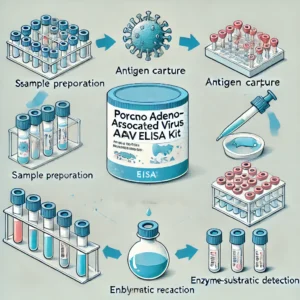
ELISA Workflow: Step-by-Step Guide
The Porcine AAV ELISA Kit employs a sandwich ELISA format, which ensures high specificity and sensitivity:
1. Sample Preparation
- Prepare biological samples by diluting them as necessary. Ensure that samples fall within the detection range of the kit.
2. Antigen Capture
- Add samples to wells pre-coated with capture antibodies specific to AAV. Incubate to allow antigen-antibody binding.
3. Secondary Antibody Binding
- Add enzyme-conjugated secondary antibodies to bind to the captured AAV particles.
4. Substrate Reaction
- Add a chromogenic substrate, such as TMB (3,3′,5,5′-Tetramethylbenzidine). The enzyme reacts with the substrate to produce a measurable color change.
5. Colorimetric Detection
- Measure the optical density at 450 nm using a microplate reader. The intensity of the color is directly proportional to the concentration of AAV in the sample.
For a comprehensive guide on ELISA principles, refer to the Centers for Disease Control and Prevention (CDC).
Advantages of Using AAV in Research
AAVs have revolutionized the fields of gene therapy and virology due to their unique properties:
- Non-Integrative
- AAVs do not integrate into the host genome, reducing the risk of mutagenesis.
- Tissue Specificity
- Certain AAV serotypes exhibit tissue-specific tropism, enabling targeted gene delivery.
- Long-Term Expression
- AAV vectors provide sustained gene expression in non-dividing cells, making them ideal for therapeutic applications.
Learn more about AAV serotypes and their applications at Addgene.
Clinical and Agricultural Implications
The Porcine AAV ELISA Kit has implications far beyond basic research:
1. Gene Therapy and Medicine
- Quantifying AAV in preclinical studies using porcine models helps bridge the gap between laboratory research and human clinical trials.
2. Veterinary Health
- Monitoring AAV levels in livestock contributes to animal health management and minimizes economic losses due to viral outbreaks.
3. Vaccine Development
- Pigs are often used in vaccine development studies, where AAV-based delivery systems are tested for efficacy and safety.
Troubleshooting Tips
- Inconsistent Results
- Ensure proper washing steps to reduce background noise and improve signal-to-noise ratio.
- Low Signal
- Optimize sample preparation and incubation times to improve antigen-antibody interactions.
- High Background
- Verify that reagents and equipment are free from contamination.
For technical support, visit Abcam Technical Resources.
Future Directions in AAV Research
The future of AAV research is bright, with ongoing advancements in gene therapy and vector engineering:
- Next-Generation Vectors
- Researchers are developing engineered AAV vectors with enhanced tissue specificity and reduced immune response.
- AAV for Vaccination
- AAVs are being explored as delivery vehicles for vaccines targeting infectious diseases such as influenza and COVID-19.
- Precision Medicine
- AAV vectors are poised to play a central role in personalized medicine, delivering tailored therapies to individual patients.
Discover the latest advancements in AAV research at PubMed Central.
Conclusion
The Porcine AAV ELISA Kit is an indispensable tool for detecting and quantifying AAV in research and diagnostic settings. Whether you are studying viral prevalence in livestock, advancing gene therapy research, or ensuring the quality of AAV production, this kit delivers the reliability and sensitivity needed to achieve your goals. With its ease of use and broad applications, the Porcine AAV ELISA Kit is an essential resource for researchers worldwide.
For purchasing or technical inquiries, consult leading suppliers such as Thermo Fisher Scientific or Abcam.