
Rabies is a fatal viral encephalitis caused by the Rabies virus, a negative-sense single-stranded RNA virus belonging to the genus Lyssavirus (family Rhabdoviridae). Comprehensive technical background on rabies virology is available through the U.S. Centers for Disease Control and Prevention (CDC):
https://www.cdc.gov/rabies/index.html
Additional molecular and epidemiological data are provided by the National Center for Biotechnology Information (NCBI):
https://www.ncbi.nlm.nih.gov/books/NBK448076/
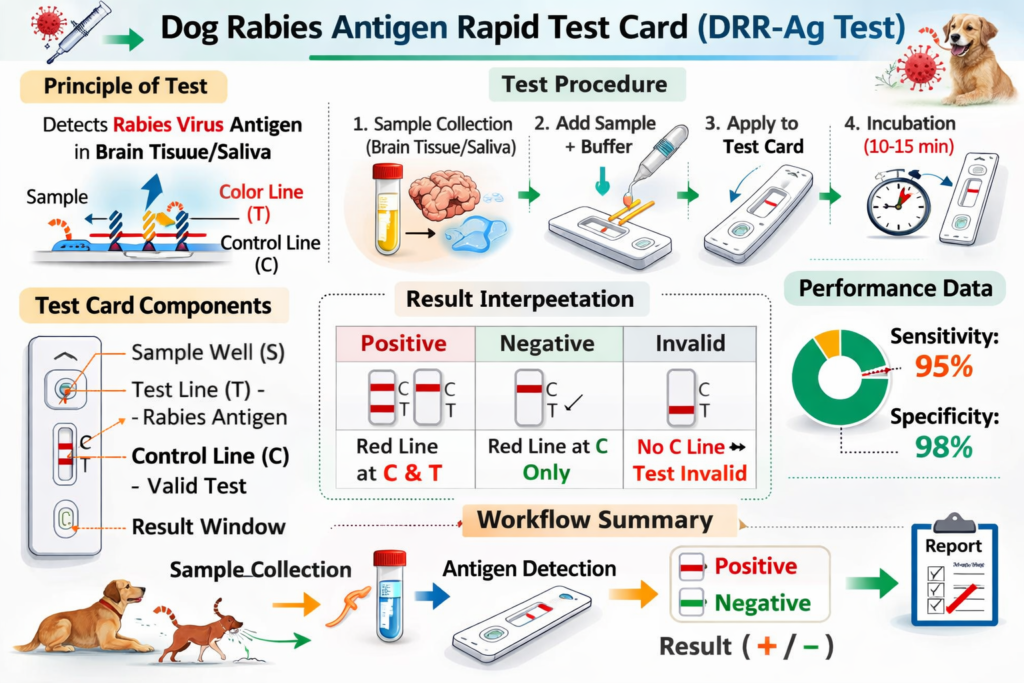
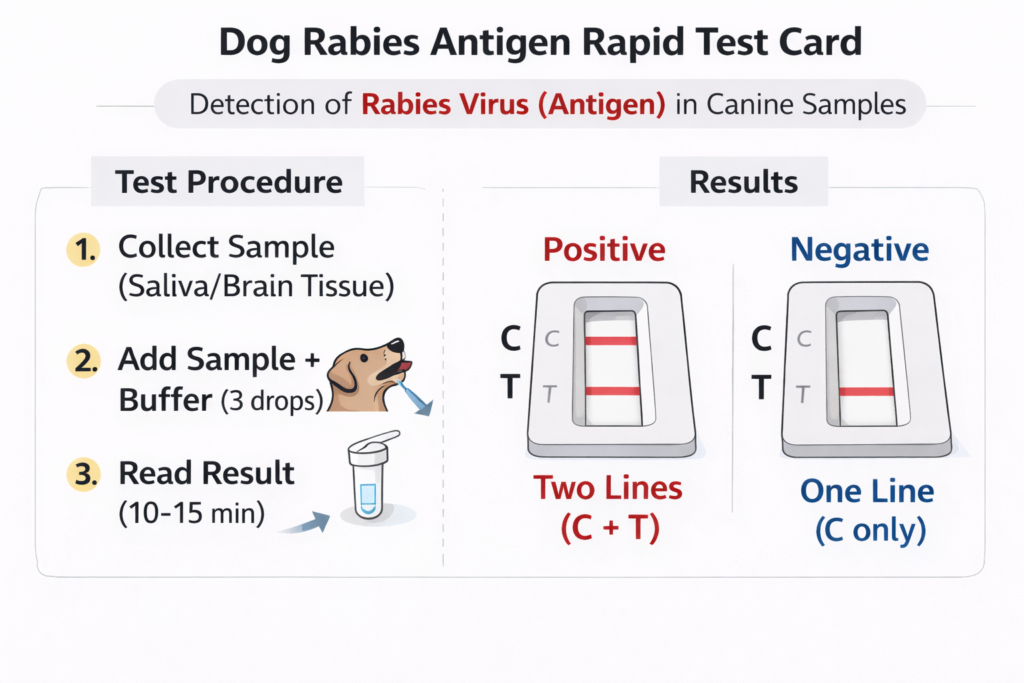
The Dog Rabies Antigen Rapid Test Card is a lateral flow immunochromatographic assay (LFIA) developed for qualitative detection of rabies virus nucleoprotein antigen in canine tissue samples. It is intended for veterinary diagnostic screening, field surveillance, and research use.
Virological and Molecular Background
Rabies virus is an enveloped, bullet-shaped virion approximately 180 × 75 nm in dimension. The genome (~12 kb) encodes five structural proteins: N, P, M, G, and L. Detailed genomic structure and replication mechanisms are described by the National Institutes of Health (NIH):
https://www.ncbi.nlm.nih.gov/pmc/articles/PMC7095390/
The nucleoprotein (N) is highly conserved and is the primary antigenic target in most antigen-detection assays. The CDC laboratory diagnostics overview describes antigen-based testing principles:
https://www.cdc.gov/rabies/diagnosis/index.html
The U.S. Department of Agriculture (USDA) also provides technical resources on rabies in domestic animals:
https://www.aphis.usda.gov/aphis/ourfocus/animalhealth/animal-disease-information/rabies
Principle of the Dog Rabies Antigen Rapid Test Card
The assay is based on lateral flow immunochromatography:
-
Sample extraction buffer solubilizes viral antigens.
-
Antigen binds to colloidal gold-conjugated monoclonal antibodies.
-
The antigen–antibody complex migrates via capillary action.
-
Immobilized anti-rabies antibodies at the test line capture the complex.
-
A visible colored band indicates antigen presence.
Technical guidance on lateral flow assay principles can be reviewed via the U.S. Food & Drug Administration (FDA):
https://www.fda.gov/medical-devices/in-vitro-diagnostics/lateral-flow-assays
Immunochromatographic assay fundamentals are further explained by NIH resources:
https://www.ncbi.nlm.nih.gov/books/NBK555922/
Sample Type and Handling Considerations
Rabies antigen detection is typically performed on brain tissue (hippocampus, cerebellum, brainstem). CDC specimen handling guidance:
https://www.cdc.gov/rabies/exposure/animals/domestic.html
Laboratory biosafety practices are described by the U.S. Department of Health & Human Services (HHS):
https://www.hhs.gov/ohrp/sachrp-committee/recommendations/attachment-biosafety.html
NIH biosafety level (BSL) guidance:
https://www.niaid.nih.gov/research/biosafety-levels
The U.S. Geological Survey (USGS) provides wildlife rabies surveillance documentation:
https://www.usgs.gov/centers/nwhc/science/rabies
Comparison with Reference Diagnostic Methods
The gold standard laboratory method for rabies confirmation is the Direct Fluorescent Antibody (DFA) test. CDC DFA protocol reference:
https://www.cdc.gov/rabies/diagnosis/dfa.html
Additional confirmatory molecular methods such as RT-PCR are described in NIH publications:
https://pubmed.ncbi.nlm.nih.gov/30401785/
European Union reference laboratory standards:
https://food.ec.europa.eu/safety/biological-safety/food-borne-diseases/rabies_en
UK governmental rabies surveillance documentation:
https://www.gov.uk/guidance/rabies
Rapid antigen tests function as screening tools and do not replace laboratory confirmation where required by regulatory frameworks.
Epidemiological Context
Rabies remains enzootic in multiple regions globally. CDC epidemiological data:
https://www.cdc.gov/rabies/location/usa/surveillance/index.html
National Institute of Allergy and Infectious Diseases (NIAID) rabies research overview:
https://www.niaid.nih.gov/diseases-conditions/rabies
MedlinePlus (U.S. National Library of Medicine) clinical overview:
https://medlineplus.gov/rabies.html
World rabies burden estimates (U.S. government global health data portal):
https://www.cdc.gov/globalhealth/healthprotection/fieldupdates/winter-2019/rabies-elimination.html
Technical Specifications (General Characteristics)
-
Assay Type: Lateral Flow Immunochromatographic Assay
-
Target Antigen: Rabies virus nucleoprotein
-
Result Format: Visual colored line (qualitative)
-
Detection Window: Minutes
-
Storage Conditions: Typically 2–30°C (manufacturer dependent)
-
Intended Use: Veterinary diagnostic screening and surveillance
Analytical Performance Considerations
Performance parameters typically evaluated include:
-
Analytical sensitivity (limit of detection)
-
Analytical specificity
-
Cross-reactivity testing
-
Reproducibility
-
Interference studies
FDA in vitro diagnostic performance documentation standards:
https://www.fda.gov/medical-devices/in-vitro-diagnostics
NIH validation guidance for diagnostic assays:
https://www.ncbi.nlm.nih.gov/books/NBK305/
Research and Surveillance Applications
The Dog Rabies Antigen Rapid Test Card supports:
-
Field surveillance programs
-
Veterinary clinic screening
-
Animal control monitoring
-
Wildlife reservoir assessment
-
Academic research studies
USDA wildlife rabies management program:
https://www.aphis.usda.gov/aphis/ourfocus/wildlifedamage/programs/nwrc/research/rabies
EPA zoonotic disease environmental considerations:
https://www.epa.gov/emergency-response/rabies
Conclusion
The Dog Rabies Antigen Rapid Test Card is a technically robust immunochromatographic diagnostic tool for rapid detection of rabies virus antigen in canine samples. Its lateral flow design allows rapid qualitative screening in veterinary and field settings, supporting structured surveillance systems.