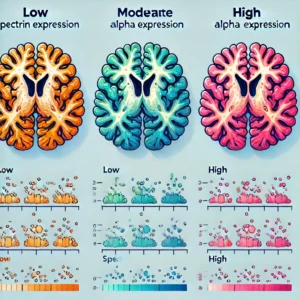
The Mouse Spectrin Alpha Chain, Brain ELISA is a highly specialized immunoassay designed to measure and quantify spectrin alpha chain levels in mouse brain tissue. Spectrin, a critical cytoskeletal protein, plays an essential role in neuronal stability and synaptic function. This assay is a vital tool for researchers investigating neurodegenerative disorders, traumatic brain injuries, and other neurological conditions.
The Role of Spectrin Alpha Chains in Brain Physiology
Spectrin is a cytoskeletal protein complex that consists of alpha and beta subunits. The alpha chain is pivotal for maintaining the integrity of neuronal membranes and anchoring proteins to the cytoskeleton. Alterations in spectrin levels or structure are often associated with neuronal damage, synaptic dysfunction, and neuroinflammation.
Biological Functions
- Membrane Stability: Spectrin stabilizes the lipid bilayer, ensuring membrane resilience under mechanical stress.
- Explore membrane dynamics at NIH Structural Biology.
- Signal Transduction: It facilitates signal propagation by organizing membrane proteins into specialized domains.
- Learn more at National Library of Medicine.
- Neuroprotection: Spectrin cleavage is involved in apoptotic pathways, a hallmark of many neurodegenerative diseases.
- Read about apoptotic pathways at CDC Apoptosis Resources.
Research Applications
1. Neurodegenerative Disorders
Spectrin degradation products, generated by calpain and caspase activity, serve as biomarkers for conditions like:
- Alzheimer’s Disease: Accumulation of beta-amyloid plaques correlates with spectrin breakdown.
- Visit NIA Alzheimer’s Resources.
- Parkinson’s Disease: Spectrin dysregulation impacts dopaminergic neuron survival.
- Find details at Parkinson’s Disease Foundation.
2. Traumatic Brain Injuries (TBI)
Spectrin cleavage products are markers of axonal injury. The ELISA assay enables rapid quantification of these products, providing insights into the extent of neuronal damage.
- Learn more at Defense and Veterans Brain Injury Center (DVBIC).
3. Epilepsy
Spectrin alpha chain interactions with ion channels impact neuronal excitability, making it a target for epilepsy research.
- Access epilepsy research resources at Epilepsy.com.
4. Stroke and Ischemia
Post-ischemic neuronal injury involves spectrin breakdown, and the ELISA serves as a critical tool for evaluating neuroprotective strategies.
- Review ischemia studies at NIH Stroke Program.
Technical Features of the ELISA Kit
The Mouse Spectrin Alpha Chain, Brain ELISA Kit is a robust tool designed with the following features:
- High Sensitivity: Detects low levels of spectrin alpha chain, suitable for subtle changes in protein expression.
- Broad Sample Compatibility: Validated for tissue homogenates, cerebrospinal fluid (CSF), and cultured cells.
- Reproducibility: Reliable results across multiple experimental replicates.
For detailed technical specifications, visit NCBI Assay Protocols.

Advantages for Researchers
- Accurate Quantification: Offers precise measurement of spectrin alpha chains to facilitate comparative studies.
- Versatile Applications: Suitable for basic research, translational studies, and preclinical investigations.
- Access preclinical resources at Science.gov.
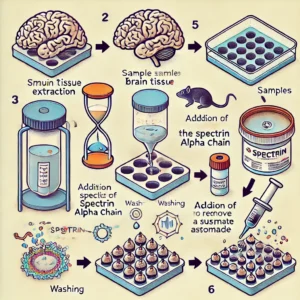
- Ease of Use: Simplified workflow with pre-coated plates and ready-to-use reagents.
- Refer to ELISA Guidelines from CDC.
Emerging Research Opportunities
As new insights emerge in neuroscience, the role of spectrin alpha chain is gaining prominence in fields such as:
- Axonal Repair: Spectrin’s involvement in axonal regeneration makes it a focus for injury recovery research.
- Learn more about axonal repair at NIH Axon Biology Resources.
- Synaptic Plasticity: Spectrin dynamics influence synapse formation and maintenance.
- Explore synaptic mechanisms at National Institute of Mental Health (NIMH).