
The Canine Nuclear Factor Kappa B p65 (NF-κB p65) ELISA Kit is a high-sensitivity assay designed for the detection and quantification of NF-κB p65 in canine biological samples such as serum, plasma, cell lysates, and tissue homogenates. NF-κB p65 is a critical transcription factor involved in the regulation of immune and inflammatory responses, making this kit an essential tool for veterinary immunology and inflammation research.
What is NF-κB p65?
Nuclear Factor Kappa B (NF-κB) is a family of transcription factors that play a key role in cellular processes such as immune responses, inflammation, cell survival, and apoptosis. The p65 subunit, also known as RelA, is one of the most studied components of the NF-κB family due to its involvement in the canonical NF-κB signaling pathway.

Key Functions of NF-κB p65:
- Regulation of Inflammatory Responses:
- Activates the expression of pro-inflammatory cytokines, chemokines, and adhesion molecules.
- Immune System Modulation:
- Controls the transcription of genes involved in innate and adaptive immunity.
- Cell Survival and Apoptosis:
- Influences genes that regulate cell proliferation, differentiation, and apoptosis.
For more information on NF-κB pathways, visit the National Center for Biotechnology Information (NCBI).
Applications of the Canine NF-κB p65 ELISA Kit
This ELISA kit is widely used in research areas such as:
- Inflammatory Disease Research
- Detects NF-κB p65 activation levels in conditions like canine arthritis, inflammatory bowel disease (IBD), and atopic dermatitis.
- Learn more about canine inflammation research at the American Veterinary Medical Association (AVMA).
- Cancer Studies
- Measures NF-κB p65 levels in tumor samples to investigate its role in cancer progression and metastasis.
- Explore cancer-related NF-κB research at PubMed Central.
- Immune System Disorders
- Assesses NF-κB activity in autoimmune diseases, such as lupus and autoimmune hemolytic anemia in dogs.
- Drug Development
- Evaluates the efficacy of anti-inflammatory drugs or NF-κB inhibitors in preclinical veterinary studies.
- Toxicology and Environmental Studies
- Examines the impact of environmental toxins on NF-κB activation in canine models.
Features of the NF-κB p65 ELISA Kit
- High Sensitivity and Specificity
- Accurately detects low levels of NF-κB p65 with minimal cross-reactivity.
- Wide Dynamic Range
- Capable of measuring a broad range of NF-κB p65 concentrations in various sample types.
- Reproducible and Reliable
- Optimized reagents and protocols ensure consistent results across experiments.
- User-Friendly Design
- Includes pre-coated plates, ready-to-use reagents, and detailed instructions for ease of use.
- Versatility
- Compatible with a wide variety of canine biological samples, including serum, plasma, cell lysates, and tissue homogenates.
For more details on the kit design, visit Thermo Fisher Scientific.
ELISA Workflow: Step-by-Step Process
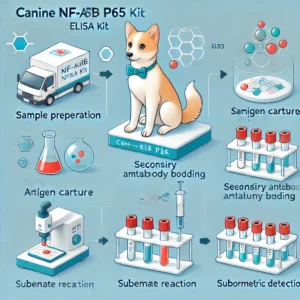
The Canine NF-κB p65 ELISA Kit uses a sandwich ELISA format to ensure accurate detection and quantification:
1. Sample Preparation
- Collect and prepare serum, plasma, or cell lysate samples as per the kit’s instructions. Dilute samples if necessary.
2. Antigen Capture
- Add samples to wells pre-coated with capture antibodies specific to canine NF-κB p65. Incubate to allow antigen binding.
3. Detection Antibody Binding
- Add enzyme-conjugated secondary antibodies to detect the bound NF-κB p65 antigen.
4. Color Development
- Add a chromogenic substrate (e.g., TMB) to the wells. The enzyme reacts with the substrate, producing a color change.
5. Quantification
- Measure the optical density at 450 nm using a microplate reader. Compare sample readings to a standard curve to determine NF-κB p65 concentrations.
For detailed ELISA protocols, refer to resources from the Centers for Disease Control and Prevention (CDC).
Advantages of Using the NF-κB p65 ELISA Kit
- Accurate Quantification
- Provides precise and reliable measurements of NF-κB p65 levels.
- Rapid and Time-Efficient
- Complete the assay in as little as 3–4 hours.
- Cost-Effective
- Suitable for high-throughput applications, reducing the cost per sample.
- Standardized Results
- Includes a robust standard curve for accurate quantification.
- Wide Applications
- Ideal for use in veterinary research, drug development, and disease modeling.
Clinical and Research Relevance of NF-κB p65
1. Inflammatory and Immune Disorders
- NF-κB p65 is a master regulator of inflammation, making it a key biomarker in diseases like arthritis, IBD, and autoimmune conditions.
2. Cancer Research
- Aberrant activation of NF-κB p65 contributes to cancer development and progression, highlighting its potential as a therapeutic target.
3. Therapeutic Development
- NF-κB inhibitors are being investigated as potential treatments for inflammatory and autoimmune diseases.
For more on NF-κB’s clinical significance, visit PubMed Central.
Troubleshooting Tips
- Low Signal
- Ensure proper sample preparation and reagent handling. Verify that the incubation times and temperatures align with the protocol.
- High Background
- Perform additional washing steps to reduce non-specific binding.
- Inconsistent Results
- Calibrate pipettes and ensure uniform handling of samples and reagents.
For technical support, refer to Abcam Technical Resources.

Future Directions in NF-κB p65 Research
- Targeted Therapies
- Development of NF-κB inhibitors for treating canine inflammatory and autoimmune diseases.
- Cancer Immunotherapy
- Exploring NF-κB as a target for enhancing anti-cancer immune responses in dogs.
- Biomarker Discovery
- Identifying NF-κB p65 as a biomarker for early diagnosis and monitoring of disease progression in canine health.
- Environmental Studies
- Studying the effects of environmental toxins on NF-κB activation in dogs as sentinel species for human health.
For the latest advancements in NF-κB research, visit PubMed Central.
Conclusion
The Canine NF-κB p65 ELISA Kit is an essential tool for researchers studying inflammatory, immune, and cancer-related pathways in canine models. Its high sensitivity, specificity, and user-friendly design make it a reliable choice for detecting and quantifying NF-κB p65 levels in various biological samples. Whether you are investigating the role of NF-κB in disease mechanisms or evaluating the efficacy of new therapeutic strategies, this kit provides the precision and reproducibility required for impactful research.