
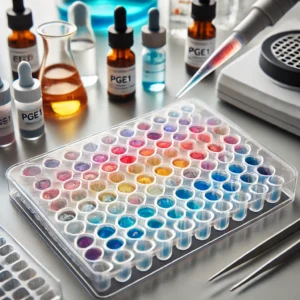
The Prostaglandin E1 (PG-E1) ELISA Kit is a highly specific and sensitive assay designed for the quantification of Prostaglandin E1 (PGE1) levels in various biological samples, such as serum, plasma, urine, tissue homogenates, and cell culture supernatants. PGE1, a bioactive lipid mediator, plays a significant role in regulating vascular tone, inflammation, and platelet aggregation. This kit is widely utilized in research focusing on cardiovascular health, inflammation, and prostaglandin signaling pathways.
What is Prostaglandin E1 (PGE1)?
PGE1 is a member of the prostaglandin family, synthesized from arachidonic acid through the action of cyclooxygenase (COX) enzymes. PGE1 is known for its potent vasodilatory, anti-inflammatory, and cytoprotective properties. It is distinct from Prostaglandin E2 (PGE2), another prominent prostaglandin involved in inflammation and pain responses.
Key Functions of PGE1:
- Vasodilation: Relaxes vascular smooth muscle to enhance blood flow.
- Anti-Thrombotic: Inhibits platelet aggregation, reducing clot formation.
- Cytoprotection: Protects tissues from ischemic injury by improving blood supply and oxygenation.
- Anti-Inflammatory: Modulates immune responses and inflammation in various physiological contexts.
For more on the biology of PGE1, visit the National Center for Biotechnology Information (NCBI).
Applications of the PGE1 ELISA Kit
The PGE1 ELISA Kit serves as a valuable tool in various research and clinical studies:
- Cardiovascular Research
- Measures PGE1 levels to study its role in managing ischemic heart disease, hypertension, and peripheral vascular diseases.
- Learn more about prostaglandins in cardiovascular health at the American Heart Association (AHA).
- Inflammation and Immune Regulation
- Quantifies PGE1 to investigate its anti-inflammatory effects in diseases like rheumatoid arthritis, sepsis, and asthma.
- Explore resources on inflammation research at the National Institutes of Health (NIH).
- Drug Development
- Evaluates the efficacy of drugs targeting COX pathways, such as prostaglandin analogs and NSAIDs.
- For insights into drug discovery, visit the FDA.
- Therapeutic Applications
- Monitors PGE1 levels in clinical trials involving its therapeutic use in managing peripheral artery disease and erectile dysfunction.
- Discover therapeutic uses of PGE1 at the World Health Organization (WHO).
- Gastrointestinal Protection
- Studies PGE1’s protective effects against gastric ulcers induced by NSAIDs.
Key Features of the PGE1 ELISA Kit
- High Sensitivity and Specificity
- Detects low concentrations of PGE1 with minimal cross-reactivity to other prostaglandins.
- Sensitivity ranges from 10–100 pg/mL, depending on the sample type.
- Rapid and Reliable
- Provides reproducible results within 3–4 hours, making it ideal for high-throughput research.
- Broad Sample Compatibility
- Suitable for various sample types, including serum, plasma, and tissue homogenates.
- User-Friendly Design
- Comes with pre-coated plates, ready-to-use reagents, and detailed protocols for ease of use.
- Wide Dynamic Range
- Accommodates a broad range of PGE1 concentrations, making it suitable for diverse research needs.
For more detailed specifications, refer to Thermo Fisher Scientific.
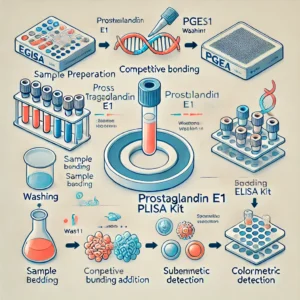
ELISA Workflow: Step-by-Step Process
The PGE1 ELISA Kit employs a competitive ELISA format, which ensures accurate quantification of PGE1:
1. Sample Preparation
- Prepare biological samples by diluting them as per the kit’s instructions. Use proper anticoagulants (e.g., EDTA or heparin) for plasma samples.
2. Competitive Binding
- Add samples and PGE1 standards to wells pre-coated with antibodies. The PGE1 in the samples competes with the labeled PGE1 for binding sites.
3. Washing
- Wash the plate to remove unbound substances and reduce background noise.
4. Substrate Reaction
- Add a chromogenic substrate (e.g., TMB) to the wells. The intensity of the color change is inversely proportional to the concentration of PGE1 in the sample.
5. Colorimetric Detection
- Measure the optical density (OD) at 450 nm using a microplate reader. Calculate PGE1 concentrations using the standard curve.
For comprehensive ELISA protocols, refer to the Centers for Disease Control and Prevention (CDC).
Clinical and Research Significance of PGE1
1. Cardiovascular Health
- PGE1’s vasodilatory and anti-thrombotic properties make it a critical mediator in cardiovascular diseases. It is often used therapeutically in peripheral artery disease and pulmonary hypertension.
2. Inflammation and Immune Modulation
- By suppressing inflammatory responses, PGE1 offers potential as a therapeutic target in conditions like sepsis, asthma, and autoimmune diseases.
3. Gastrointestinal Health
- PGE1 analogs are used clinically to prevent gastric ulcers caused by NSAIDs.
4. Therapeutic Potential
- Synthetic PGE1 is utilized in managing erectile dysfunction and improving blood flow in ischemic conditions.
For insights into PGE1’s therapeutic applications, visit PubMed Central.
Advantages of the PGE1 ELISA Kit
- Precise Quantification
- Ensures reliable measurement of PGE1 levels across a variety of sample types.
- Time-Efficient
- Complete assay in just a few hours, making it suitable for time-sensitive experiments.
- Cost-Effective
- Ideal for high-throughput applications, reducing per-sample costs.
- Standardized Results
- Provides robust standard curves for accurate quantification.
- Wide Applications
- Applicable to research in cardiovascular health, inflammation, and pharmacology.
Troubleshooting Tips
- Low Signal
- Verify proper storage and handling of reagents. Ensure sample preparation aligns with protocol instructions.
- High Background
- Perform additional washing steps to reduce non-specific binding.
- Inconsistent Results
- Calibrate pipettes and ensure uniform sample handling.
For technical support, visit Abcam Technical Resources.

Future Directions in PGE1 Research
- Biomarker Development
- PGE1 is being explored as a biomarker for early detection of cardiovascular diseases and inflammatory disorders.
- Targeted Therapies
- Research is focused on developing PGE1-based therapies for ischemic conditions and vascular dysfunction.
- Personalized Medicine
- Measuring PGE1 levels may help tailor treatments for individual patients, enhancing therapeutic outcomes.
- Prostaglandin Signaling
- The study of prostaglandin signaling pathways is expanding, offering new insights into their role in health and disease.
Stay updated on PGE1 research advancements at PubMed Central.
Conclusion
The Prostaglandin E1 (PGE1) ELISA Kit is a vital tool for researchers studying cardiovascular health, inflammation, and prostaglandin biology. Its high sensitivity, specificity, and user-friendly design make it an indispensable resource for quantifying PGE1 levels in various biological samples. Whether you are investigating PGE1’s role in vascular health or evaluating its therapeutic potential, this kit provides reliable and reproducible results.
For purchasing or further information, consult trusted suppliers such as Thermo Fisher Scientific or Abcam.