
Rabies is a fatal viral zoonosis that poses a significant threat to both animal and human health worldwide. Effective management and prevention rely on early detection and vaccination programs. The Canine Rabies Antibody Rapid Test Kit has become an indispensable tool for monitoring rabies vaccination efficacy and overall canine immunity. This article provides an in-depth look at its applications, mechanisms, and importance in rabies control programs.
Understanding Rabies and Its Global Impact
Rabies is caused by a neurotropic virus belonging to the Lyssavirus genus. It is primarily transmitted through the bite or saliva of infected animals, with domestic dogs being the leading source of human rabies deaths.
- Learn more about rabies epidemiology from the Centers for Disease Control and Prevention (CDC).
- Explore global rabies data at the World Health Organization (WHO).
- Review rabies transmission dynamics at the National Institute of Health (NIH).
The Role of Antibody Detection in Rabies Prevention
Antibody detection is crucial in evaluating the success of rabies vaccination. The presence of rabies-neutralizing antibodies indicates immunity, providing assurance against potential rabies exposure. Monitoring canine immunity is particularly important in high-risk areas where dogs serve as reservoirs for the virus.
- Discover the importance of rabies-neutralizing antibodies at CDC Vaccination Guidelines.
- Read about antibody-mediated immunity in rabies at NIH Research Resources.
Overview of the Canine Rabies Antibody Rapid Test Kit
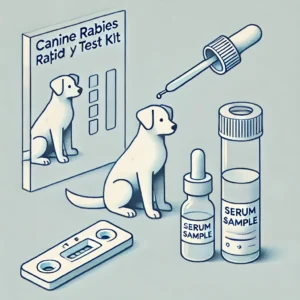
The Canine Rabies Antibody Rapid Test Kit is a lateral flow immunoassay designed for the qualitative detection of rabies-neutralizing antibodies in canine serum or plasma. It is portable, easy to use, and provides rapid results within minutes, making it ideal for field diagnostics and large-scale vaccination campaigns.
- Learn about lateral flow assay principles at NIH Diagnostic Methods.
- Review rapid test kits’ applications at FDA Point-of-Care Testing.

Features of the Canine Rabies Antibody Rapid Test Kit
- Ease of Use
The test requires minimal technical expertise, enabling veterinarians and field workers to use it effectively.- Explore user-friendly diagnostic tools at CDC Laboratory Training Resources.
- Fast Results
Results are available within 5-10 minutes, significantly reducing waiting time compared to traditional laboratory methods.- Compare rapid diagnostics to conventional methods at FDA Diagnostic Innovations.
- High Specificity and Sensitivity
The kit offers reliable performance, minimizing false positives and negatives.- Review assay sensitivity standards at NIH Bioassay Validation.
- Field Applicability
Its portability and robustness make it ideal for remote locations and areas with limited laboratory access.- Discover field diagnostics technologies at CDC Global Health Programs.
Applications in Rabies Control Programs
1. Vaccination Monitoring
The rapid test kit is widely used to evaluate the efficacy of rabies vaccination programs in dogs. It ensures that vaccinated animals develop sufficient antibody titers for protection.
- Learn about rabies vaccination strategies at WHO Rabies Prevention.
2. Epidemiological Surveillance
The kit aids in identifying immune gaps within canine populations, guiding public health interventions.
- Explore rabies surveillance methods at CDC Rabies Data and Statistics.
3. Pre-Exposure Prophylaxis (PEP) Validation
Ensuring adequate antibody levels in at-risk animals is critical for PEP protocols.
- Read about PEP guidelines at CDC Rabies Prevention.

Challenges and Future Directions
While the Canine Rabies Antibody Rapid Test Kit provides numerous advantages, challenges like cost, accessibility, and occasional variations in test accuracy need to be addressed. Ongoing research aims to improve the kit’s performance and affordability.
- Learn about the economics of rabies diagnostics at CDC Rabies Cost Information.
- Explore advancements in rabies testing at NIH Emerging Technologies.
Conclusion
The Canine Rabies Antibody Rapid Test Kit is a cornerstone in the fight against rabies, enabling swift, reliable, and field-friendly antibody detection. Its role in vaccination monitoring and epidemiological surveillance underscores its importance in achieving the global goal of eliminating canine-mediated rabies.
For additional resources:
By integrating such advanced tools into public health initiatives, we can take significant strides toward rabies eradication.