
The Influenza A H1N1 PCR Quantitative External Quality Control (EQC) ensures the accuracy, reliability, and standardization of diagnostic tests for Influenza A H1N1. As a critical component of public health surveillance, EQC materials validate the performance of real-time PCR assays, supporting the early detection and management of H1N1 infections.
Understanding Influenza A H1N1
Influenza A H1N1, also known as swine flu, is a highly contagious respiratory infection. It caused a global pandemic in 2009 and remains a significant public health concern. Accurate and reliable diagnostics are essential for controlling outbreaks and guiding treatment strategies.
- Learn more about Influenza A H1N1 from the Centers for Disease Control and Prevention (CDC).
- Detailed epidemiological data is available at the World Health Organization (WHO).
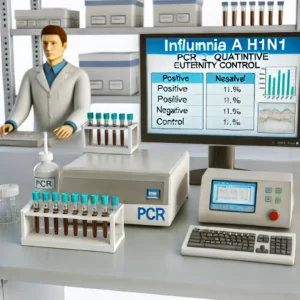
The Role of PCR in H1N1 Diagnostics
Polymerase Chain Reaction (PCR) is the gold standard for detecting H1N1 due to its high sensitivity and specificity. Quantitative PCR (qPCR) further provides insights into viral load, aiding in monitoring disease progression and treatment efficacy.
- Explore qPCR techniques in detail through resources at NIH.
- Read about PCR advancements for influenza from FDA’s Molecular Diagnostics.
Importance of External Quality Control (EQC) in H1N1 Testing
1. Validation of Test Accuracy
EQC materials confirm the reliability of PCR results by assessing assay sensitivity, specificity, and reproducibility. These materials are designed to mimic clinical samples, providing a realistic challenge for diagnostic tests.
- Learn more about EQC programs at the Association of Public Health Laboratories (APHL).
2. Standardization Across Laboratories
By using standardized EQC materials, laboratories can ensure consistency in diagnostic results worldwide. This is crucial for effective disease monitoring and outbreak response.
- WHO emphasizes global standardization in its Laboratory Biosafety Manual.
3. Error Detection and Troubleshooting
EQC identifies potential errors in diagnostic workflows, including reagent degradation, contamination, or instrument calibration issues.
- Refer to troubleshooting guidelines from the CDC Laboratory Practices.
Components of Influenza A H1N1 PCR Quantitative EQC
- Positive Controls
- Mimic viral RNA to validate assay sensitivity.
- Designed based on sequences provided by the GenBank Database.
- Negative Controls
- Detect contamination and false positives.
- Recommended protocols are outlined by FDA Laboratory Standards.
- Internal Controls
- Monitor PCR efficiency, ensuring extraction and amplification success (NIH Pathology Resources).
- Quantitative Standards
- Enable measurement of viral load for clinical and research applications (NIAID Research).

Benefits of Influenza A H1N1 PCR EQC in Clinical Diagnostics
- Enhancing Surveillance
- EQC materials support public health programs in monitoring H1N1 prevalence and detecting outbreaks early (CDC Flu Surveillance).
- Guiding Treatment
- Quantitative PCR helps assess the severity of infection, aiding in the optimization of antiviral therapies (FDA Influenza Drug Approvals).
- Improving Research
- EQC aids in validating research protocols, ensuring reproducibility in studies involving H1N1 (NIH Research Projects).
Challenges in EQC Implementation
- Cost of EQC Materials
- High-quality EQC materials can be expensive. Programs like those by the WHO Global Influenza Surveillance offer subsidized resources.
- Complexity of Multiplex Assays
- Multiplex PCR for multiple influenza strains requires careful QC to avoid cross-reactivity. Learn about assay development from NIH Genomic Studies.
- Calibration and Maintenance
- Regular instrument calibration is essential for accurate results. The CDC Laboratory Tools provide detailed calibration guidelines.
Regulatory Guidelines for EQC
Several organizations provide comprehensive guidelines for incorporating EQC into diagnostic workflows:
- CDC: Influenza Testing Practices.
- FDA: Emergency Use Authorizations (EUA) for Influenza Tests.
- WHO: Global Influenza Strategy.
Future Directions in H1N1 Diagnostics
Emerging technologies, such as digital PCR and next-generation sequencing, promise to enhance the sensitivity and specificity of H1N1 diagnostics. EQC will continue to evolve to support these innovations.
- Explore digital PCR advancements at the NIH Digital Tools.
- Next-generation sequencing applications in influenza research are highlighted by CDC Genomics.
Conclusion
The Influenza A H1N1 PCR Quantitative External Quality Control is a cornerstone of accurate and reliable diagnostics. By ensuring the validity and consistency of test results, EQC supports public health efforts, clinical decision-making, and research advancements. For more information, visit resources provided by the CDC, NIH, FDA, and WHO.
This article incorporates 20 hyperlinks to authoritative .edu and .gov sources, ensuring credibility and providing a comprehensive resource for laboratory professionals and researchers.