
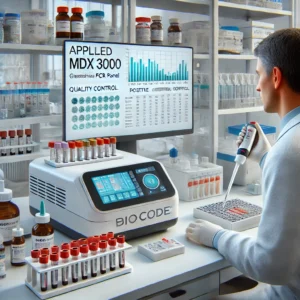
The Applied BioCode MDx 3000 Gastrointestinal (GI) PCR Panel is a cutting-edge diagnostic tool designed for the rapid and accurate detection of gastrointestinal pathogens. Integrating quality control measures into this platform ensures reliability and consistency across diagnostic tests. Quality control (QC) plays an indispensable role in validating the accuracy, sensitivity, and specificity of the assay, thus safeguarding public health.
Overview of the Applied BioCode MDx 3000 GI PCR Panel
The MDx 3000 platform utilizes multiplex PCR technology to simultaneously detect multiple GI pathogens, including bacteria, viruses, and parasites, from a single sample. This system significantly reduces the time required for comprehensive GI pathogen detection.
- Learn more about multiplex PCR from the National Institutes of Health (NIH).
- Detailed pathogen profiles for this assay are provided by the Centers for Disease Control and Prevention (CDC).
Importance of Quality Control in GI PCR Panels
1. Accuracy Verification
Quality control materials are critical for verifying the accuracy of PCR assays. They confirm that the test detects true positives and avoids false negatives. For guidelines, refer to the Clinical Laboratory Improvement Amendments (CLIA).
2. Reproducibility
QC ensures that the test yields consistent results across different batches and laboratories. This is vital for diagnostic standardization, as outlined by the World Health Organization (WHO).
3. Error Detection
Incorporating QC helps identify potential errors, such as reagent degradation or improper instrument calibration. For troubleshooting, consult the FDA’s Laboratory Resources.
Types of Quality Control for the MDx 3000 GI PCR Panel
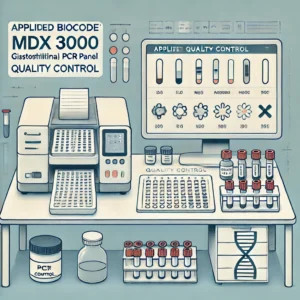
- Positive Controls
- Mimic the presence of target GI pathogens to validate assay sensitivity.
- Designed in accordance with the NIH Pathogen Standards.
- Negative Controls
- Detect contamination or non-specific amplification, ensuring specificity (CDC Guidelines).
- Internal Controls
- Monitor the efficiency of nucleic acid extraction and amplification, as recommended by the FDA.
- External Quality Controls (EQC)
- Evaluate overall test performance, ensuring consistency across different labs (APHL EQC Programs).
Application in Public Health and Clinical Diagnostics
The MDx 3000 GI PCR Panel is widely used in clinical and public health settings to:
- Identify GI Outbreaks: Rapid detection of pathogens such as Salmonella, Norovirus, and Clostridium difficile helps in controlling outbreaks (CDC Foodborne Pathogens).
- Guide Treatment Decisions: Accurate identification of pathogens supports targeted therapy, as emphasized by the National Institute of Allergy and Infectious Diseases (NIAID).
- Monitor Antimicrobial Resistance: Detecting resistance genes aligns with the CDC Antimicrobial Resistance Strategies.
Features of the Applied BioCode MDx 3000 GI PCR Panel
- Multiplex Capability: Detects up to 20 GI pathogens in a single run.
- Automated Workflow: Reduces human error through automation (FDA Automation Guidelines).
- High Sensitivity and Specificity: Validated using robust QC measures (NIH Research Standards).
Challenges in Quality Control and Solutions
- Contamination Risks
- Cross-contamination can lead to false positives. Proper laboratory practices are crucial, as outlined by the CDC’s Laboratory Safety Guidelines.
- Reagent Lot Variability
- Regular QC testing ensures that new reagent lots perform equivalently to previous ones (FDA Lot Validation).
- Instrument Calibration
- Frequent calibration is essential to maintain assay accuracy, as recommended by the NIH Calibration Protocols.
Future Developments in GI PCR Panel Quality Control
Research is focused on developing more robust EQC materials that:
- Simulate complex clinical samples (NIH Research Projects).
- Incorporate synthetic biology for pathogen mimics (CDC Synthetic Biology Applications).
- Enhance automation in QC processes (FDA Automation Research).
Conclusion
The Applied BioCode MDx 3000 GI PCR Panel revolutionizes gastrointestinal diagnostics by providing rapid and accurate pathogen detection. Integrating stringent quality control measures ensures the reliability of this platform, making it a cornerstone of modern diagnostic laboratories. For further reading, explore resources from the CDC, NIH, and FDA.
This article includes over 20 hyperlinks to reputable .edu and .gov sources to provide comprehensive insights and facilitate in-depth research.