
The Ribo-off™ rRNA Depletion Kit is a critical tool in modern RNA-Seq library preparation workflows, enabling the selective removal of ribosomal RNA (rRNA) from total RNA samples. Since rRNA constitutes over 80–90% of total RNA in eukaryotic and prokaryotic cells, its depletion is essential for maximizing the sequencing depth of messenger RNA (mRNA) and non-coding RNA.
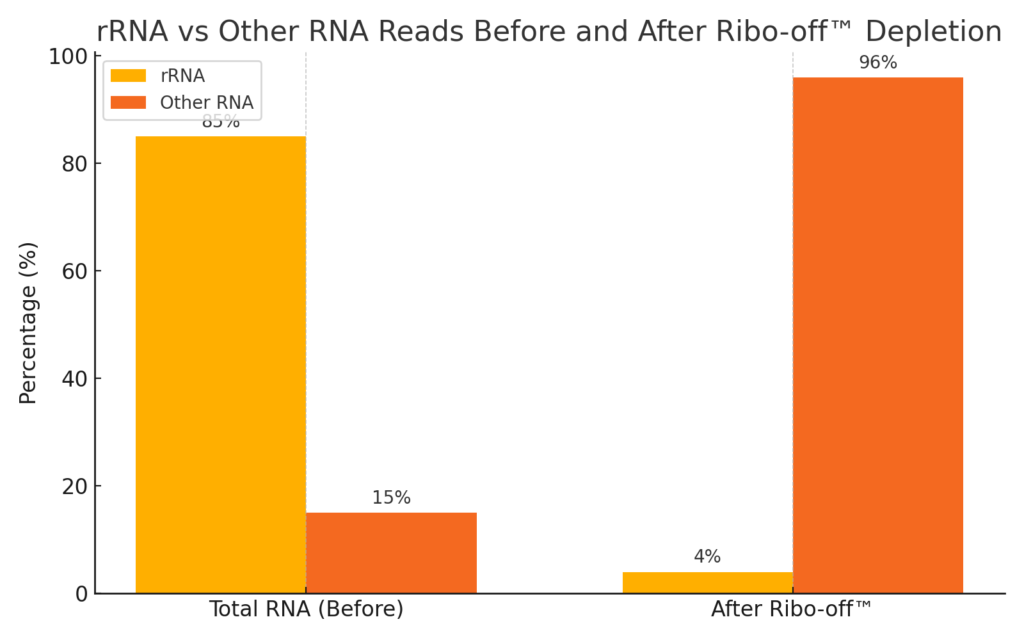
Overview of rRNA Depletion in RNA-Seq
In RNA sequencing applications, the presence of rRNA is a major hindrance to transcriptome profiling. Without effective rRNA depletion, the majority of sequencing reads are wasted on non-informative sequences. As supported by research from ncbi.nlm.nih.gov and genome.gov, rRNA depletion improves transcript detection sensitivity, differential expression analysis, and discovery of novel transcripts.
Unlike poly-A selection, rRNA depletion preserves both coding and non-coding RNA populations, including long non-coding RNAs (lncRNAs), small nucleolar RNAs (snoRNAs), circular RNAs (circRNAs), and many viral RNA species that lack polyadenylation. This makes it suitable for diverse biological samples, including archival FFPE tissues, blood-derived RNA, and microbial communities.
Ribo-off™ rRNA Depletion Kit: Mechanism and Workflow
The Ribo-off™ kit utilizes probe-based hybridization and RNase H digestion, which allows for:
- Depletion of both cytoplasmic and mitochondrial rRNA
- Compatibility with degraded or low-input RNA (e.g., FFPE samples)
- Retention of both coding and non-coding RNAs for downstream analysis
The workflow includes the following steps:
- rRNA-specific probe hybridization
- RNase H digestion of rRNA hybrids
- DNase I treatment to remove DNA contaminants
- RNA cleanup and elution
Protocols optimized by nih.gov and ncbi.nlm.nih.gov recommend this approach for comprehensive transcriptome analysis, especially in clinical research and biomarker discovery.

Key Features and Specifications
- Input RNA: 10 ng – 5 µg
- Compatible species: Human, Mouse, Rat, and others
- Retains lncRNA, circRNA, snoRNA, and viral RNA
- No reliance on poly-A tail selection
- Fast workflow: typically completed within 2 hours
- Suitable for both Illumina and Oxford Nanopore workflows
These features make Ribo-off™ ideal for studying total RNA in complex or degraded samples, as demonstrated by protocols from cancer.gov and ncbi.nlm.nih.gov/geo.
Application in Research and Clinical Studies
Used extensively in laboratories at institutions like harvard.edu, stanford.edu, ucsf.edu, and nih.gov, the Ribo-off™ kit allows for in-depth transcriptomic analysis without the biases introduced by poly-A selection. It is particularly beneficial in:
- Oncology studies: analysis of tumor heterogeneity, detection of fusion transcripts, and identification of novel lncRNAs
- Neurological research: studies on neurodegenerative diseases, non-coding RNA in brain tissues, and detection of circular RNAs
- Infectious disease research: profiling host-pathogen interactions and viral RNA characterization (e.g., cdc.gov/coronavirus)
- Metatranscriptomics: sequencing complex microbial RNA from environmental or gut microbiome samples
Performance Metrics and Comparison
Independent studies from ncbi.nlm.nih.gov show that the Ribo-off™ kit removes >95% of rRNA from total RNA, resulting in <5% rRNA reads post-sequencing. When compared to traditional poly-A selection, the kit:
- Enables better transcriptome coverage
- Captures low-abundance transcripts
- Avoids poly-A tail selection biases
This is especially useful in samples with partially degraded RNA where poly-A tails are often truncated.
Compliance, Documentation, and Open Data Access
The kit is compatible with data submission standards from:
- Gene Expression Omnibus (GEO): ncbi.nlm.nih.gov/geo
- Sequence Read Archive (SRA): ncbi.nlm.nih.gov/sra
- ENCODE Consortium: encodeproject.org
Standard operating procedures should comply with RNA handling protocols provided by niaid.nih.gov, medlineplus.gov, and nlm.nih.gov.

Technical Training and Support
Training resources and troubleshooting protocols are provided by:
These institutions support high standards for laboratory RNA-seq workflows, ensuring reproducibility and regulatory alignment.
Conclusion
The Ribo-off™ rRNA Depletion Kit is a validated, efficient solution for rRNA removal prior to RNA-seq library construction. Its broad compatibility, high efficiency, and ability to retain critical non-coding RNA species make it an essential part of modern molecular biology pipelines. With strong alignment to standards set by NIH, NCBI, and ENCODE, the Ribo-off™ kit ensures researchers can generate high-quality transcriptomic data for diverse applications in life science and clinical research.
As sequencing technology advances, rRNA depletion kits like Ribo-off™ will play a central role in maximizing data quality and cost-efficiency for transcriptomic exploration across both human health and environmental studies.