
The Goat Anti-GAPDH Polyclonal IgG Antibody is widely used in molecular biology, particularly in Western blotting, immunofluorescence, ELISA, and flow cytometry to detect Glyceraldehyde 3-phosphate dehydrogenase (GAPDH). This housekeeping protein is frequently employed as an internal control due to its stable and ubiquitous expression in various cell types.
What is GAPDH?
GAPDH (Glyceraldehyde-3-phosphate dehydrogenase) is a key enzyme in the glycolytic pathway that catalyzes the sixth step of glycolysis. It is also involved in nuclear functions, including DNA repair and RNA transport.
Why Use a Goat Polyclonal Antibody?
Goat polyclonal antibodies are valued for:
-
High yield and affinity
-
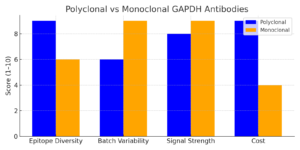
Greater epitope recognition diversity
-
Lower background in Western blots compared to rabbit or mouse sources in some systems
-
Cost-effective production
Explore related immunology fundamentals:
Applications
🔬 Western Blotting (WB)
Used to verify protein loading or expression across experimental conditions.
💡 Immunofluorescence (IF)
Allows subcellular localization of GAPDH in tissue sections or cultured cells.
🧪 ELISA
Quantitative detection of GAPDH levels in lysates.
📊 qPCR Normalization
Though not a direct antibody application, GAPDH is commonly used as a reference gene.
Validation and Specificity
-
The antibody is validated for specificity via peptide competition assay.
-
It recognizes a single ~36 kDa band on Western blots.
-
Tested in HEK293, HeLa, and Jurkat cells.
Learn more about antibody validation standards:
Technical Specifications
| Feature | Details |
|---|---|
| Host Species | Goat |
| Antibody Type | Polyclonal IgG |
| Immunogen | Recombinant GAPDH peptide |
| Purification | Affinity purified |
| Format | Liquid or lyophilized |
| Recommended Dilution | 1:1000 – 1:10,000 (WB) |
| Storage | -20°C long term, 4°C short term |
Storage and Stability
-
Store at –20°C for long-term use.
-
Avoid repeated freeze-thaw cycles.
-
Diluted antibody solutions should be used within 1 week at 4°C.
See: NIH Antibody Handling Guide
Troubleshooting
| Problem | Cause | Solution |
|---|---|---|
| High background | Non-specific binding | Increase blocking or dilution |
| Weak signal | Low antibody concentration | Optimize antibody incubation time |
| Multiple bands | Cross-reactivity | Perform peptide competition assay |
Further reading:
Advantages of Polyclonal Antibodies
-
Recognize multiple epitopes
-
Work well in denatured and native protein states
-
More robust in varying experimental conditions
Review comparison:

Frequently Asked Questions
Can I use it in mouse tissue?
Yes, most GAPDH antibodies are cross-reactive with mouse, rat, and human.
Is this antibody suitable for fluorescent imaging?
Yes, conjugated versions (e.g., FITC, Alexa Fluor) are available.
How is the antibody purified?
Typically, via protein G affinity chromatography.
Related Techniques and Resources
Conclusion
The Goat Anti-GAPDH Polyclonal IgG Antibody is a versatile, cost-effective, and reliable tool for protein detection in molecular biology, biotechnology, and biomedical research. Its high cross-species reactivity and strong signal-to-noise ratio make it ideal for multiple assay types. With proper validation, it serves as a robust internal control across applications.