
Introduction
Rabies remains a serious zoonotic disease that poses a significant threat to both animal and human populations. The disease is nearly always fatal once clinical symptoms appear, making early detection and preventive measures crucial. Canine Rabies Antigen Rapid Test Kits have emerged as a promising tool for quick and accessible diagnosis, particularly in areas with limited laboratory facilities. This article explores the functionality, accuracy, regulatory considerations, and practical applications of these test kits, providing authoritative references from educational and government sources.
Understanding Rabies in Canines
Rabies is caused by the rabies virus, a member of the Rhabdoviridae family, which primarily affects the central nervous system. The virus is transmitted through the saliva of infected animals, usually via bites. Once the virus enters the nervous system, it progresses rapidly, leading to severe neurological symptoms and death (CDC). Dogs serve as the primary reservoir of rabies in many parts of the world, making rabies control in canines essential for public health (WHO).
Functionality of Canine Rabies Antigen Rapid Test Kits
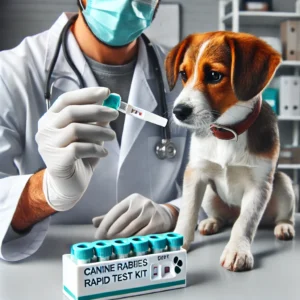
Canine Rabies Antigen Rapid Test Kits are immunochromatographic assays that detect rabies virus antigens in animal tissues. The test utilizes monoclonal antibodies that bind specifically to rabies virus antigens. The presence of the virus triggers a colorimetric reaction, allowing for visual interpretation of results. These kits offer several advantages, including:
- Rapid results (typically within 10–20 minutes)
- Minimal equipment requirements
- Ease of use in field conditions
Despite these benefits, the gold standard for rabies diagnosis remains the Direct Fluorescent Antibody (DFA) test, which is recommended by the CDC and WHO (CDC, WHO).
Performance and Accuracy of Rabies Rapid Test Kits
The effectiveness of rabies rapid test kits has been the subject of various studies. A comparative evaluation of six commercially available kits demonstrated variable sensitivity and specificity, ranging from 0% to 100% depending on the test and sample quality (PubMed). The findings highlighted the importance of selecting validated kits with high diagnostic accuracy before deploying them in the field.
In another study, an immunochromatographic test strip (ICTS) for detecting rabies virus antibodies showed high specificity and a detection limit of 0.5 IU/ml, comparable to the Fluorescent Antibody Virus Neutralization (FAVN) test (NIH). This underscores the potential of rapid test kits in rabies surveillance and control programs, particularly in resource-limited settings.

Regulatory Considerations and Challenges
Despite the growing interest in rapid test kits, there are no USDA-licensed rapid diagnostic kits for rabies as of now. The use of unvalidated rapid tests raises concerns regarding:
- False negatives, which may result in the misclassification of infected animals
- False positives, leading to unnecessary euthanasia or incorrect public health responses
- Lack of standardized protocols for field application
The gold standard remains laboratory-based methods such as the DFA test, which requires trained personnel and specialized equipment (USDA, CDC).
Field Applications and Case Studies
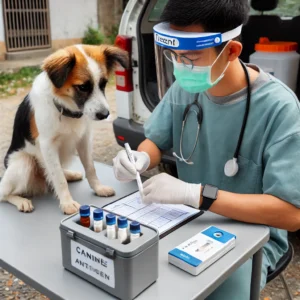
In regions where laboratory infrastructure is lacking, rapid test kits have been deployed for preliminary screening. A pilot study in Africa demonstrated that on-site rapid testing, combined with confirmatory DFA testing, improved surveillance efficiency and reduced diagnostic turnaround times (WHO).
Similarly, a study in Asia found that integrating rabies rapid testing into routine surveillance programs significantly enhanced the ability to detect and control outbreaks in stray dog populations (NIH).
Future Perspectives and Innovations
Given the limitations of current rapid test kits, ongoing research aims to improve their reliability and accessibility. Advancements in molecular diagnostics and nanotechnology-based biosensors offer promising alternatives for rapid, highly sensitive, and field-deployable rabies detection (CDC, NIH), including:
- CRISPR-based detection methods for high specificity
- Portable PCR devices for field confirmation
- Smartphone-integrated lateral flow assays for real-time reporting
Conclusion
Canine Rabies Antigen Rapid Test Kits offer a promising tool for preliminary rabies screening, particularly in remote and resource-limited areas. However, their performance varies, and they should not replace laboratory-confirmed tests like DFA. Regulatory oversight, continued research, and improved kit validation are essential to enhance their reliability for effective rabies control and prevention.
For more information on rabies diagnosis and prevention, visit:
- World Health Organization
- Centers for Disease Control and Prevention
- USDA Animal and Plant Health Inspection Service
By integrating scientific advancements and regulatory oversight, rabies rapid test kits could play a vital role in achieving the global goal of eliminating dog-mediated human rabies deaths by 2030 (WHO).