
The Chicken Annexin A5 (ANXA5) ELISA Kit is a quantitative sandwich enzyme-linked immunosorbent assay developed for the measurement of Annexin A5 protein in avian biological matrices. The assay is optimized for serum, plasma, tissue homogenates, and cell culture supernatants and is intended for research use in poultry biology, veterinary science, and molecular signaling studies.
Molecular and Structural Background of Annexin A5
Annexin A5 (ANXA5) is a Ca²⁺-dependent phospholipid-binding protein belonging to the annexin superfamily. The gene and protein reference data are available through:
-
NCBI Gene database (NIH):
https://www.ncbi.nlm.nih.gov/gene -
NCBI Protein database:
https://www.ncbi.nlm.nih.gov/protein -
National Library of Medicine (NLM) protein overview:
https://medlineplus.gov/genetics/gene/anxa5/
Annexins share conserved domains responsible for membrane association in the presence of calcium ions. Structural and biochemical data can be reviewed through:
-
NIH PubMed Central:
https://www.ncbi.nlm.nih.gov/pmc/ -
Protein Data Bank (RCSB PDB, supported by U.S. NSF/NIH):
https://www.rcsb.org
Annexin A5 binds phosphatidylserine (PS) exposed on apoptotic cell membranes. Apoptosis signaling pathways are described by:
-
National Institute of General Medical Sciences (NIGMS):
https://www.nigms.nih.gov/education/fact-sheets/Pages/cell-death.aspx -
National Cancer Institute (NCI):
https://www.cancer.gov/publications/dictionaries/cancer-terms/def/apoptosis
In avian systems, Annexin A5 is studied in immune modulation, embryogenesis, and viral infection models relevant to poultry health research. U.S. Department of Agriculture (USDA) poultry research resources:
https://www.ars.usda.gov/research/programs-projects/project/?accnNo=436236
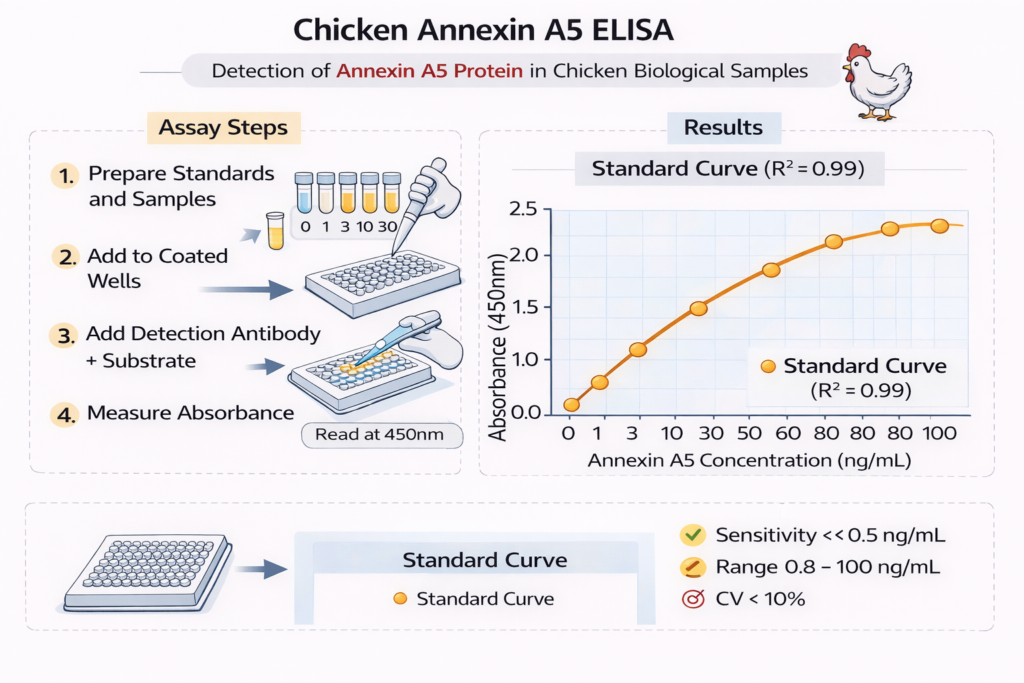
Assay Principle – Sandwich ELISA Methodology
The Chicken Annexin A5 ELISA operates on a sandwich ELISA format. General ELISA methodology is described by:
-
NIH Office of Intramural Research:
https://oir.nih.gov/sourcebook/ethical-conduct/research-ethics/elisa -
U.S. Food & Drug Administration (FDA) in vitro diagnostics overview:
https://www.fda.gov/medical-devices/in-vitro-diagnostics
Assay mechanism:
-
Microplate wells are pre-coated with anti-chicken Annexin A5 capture antibody.
-
Samples and standards bind to immobilized antibodies.
-
Biotinylated detection antibody forms an antibody–antigen–antibody complex.
-
Streptavidin–HRP conjugate binds biotin.
-
TMB substrate is oxidized by HRP.
-
Absorbance is measured at 450 nm.
Colorimetric enzyme kinetics principles are detailed in NIH biochemical assay references:
https://www.ncbi.nlm.nih.gov/books/NBK555922/
Sample Preparation and Handling
Appropriate biological sample processing is critical for quantitative reproducibility. Laboratory best practices are outlined by:
-
NIH Laboratory Safety Guidelines:
https://ors.od.nih.gov/sr/dohs/safety/laboratory/Pages/default.aspx -
CDC Biosafety in Microbiological and Biomedical Laboratories (BMBL):
https://www.cdc.gov/labs/BMBL.html
Typical sample types:
-
Chicken serum
-
EDTA or heparin plasma
-
Tissue homogenates
-
Cell culture supernatants
Anticoagulant considerations are documented by the NIH Clinical Center:
https://www.cc.nih.gov/ccc/patient_education/pepubs/labtest.pdf
![AffiELISA® Chicken Annexin A5 ELISA [ ANXA5]](https://affigen.com/cdn/shop/files/5BAFG-E4345_5D_20AffiELISA_C2_AE_20Cattle_20IFNg_20Kit_20High-Resolution_20Interferon_20Gamma_20ELISA_20Detection_b7ad6a20-e068-4e38-a044-f11d7567c5d2_535x.png?v=1712822944)
Analytical Performance Parameters
Analytical validation typically includes:
-
Sensitivity (Limit of Detection, LOD)
-
Specificity (cross-reactivity testing)
-
Linearity
-
Precision (intra- and inter-assay CV%)
-
Recovery
-
Parallelism
FDA performance evaluation guidance for immunoassays:
https://www.fda.gov/regulatory-information/search-fda-guidance-documents/analytical-procedures-and-methods-validation
NIH assay validation principles:
https://www.ncbi.nlm.nih.gov/books/NBK305/
Standard curve modeling using four-parameter logistic regression (4PL) is described in NIH biostatistics documentation:
https://www.ncbi.nlm.nih.gov/pmc/articles/PMC4263697/
Apoptosis and Phosphatidylserine Binding Relevance
Annexin A5 is widely used as a marker of apoptosis due to its binding to phosphatidylserine exposed on apoptotic membranes.
Mechanistic background:
-
National Human Genome Research Institute (NHGRI):
https://www.genome.gov/genetics-glossary/Apoptosis -
NCBI Apoptosis review articles:
https://www.ncbi.nlm.nih.gov/books/NBK26873/
In poultry research, apoptosis is relevant in:
-
Viral pathogenesis
-
Immune response modulation
-
Developmental biology
USDA Animal and Plant Health Inspection Service (APHIS) research overview:
https://www.aphis.usda.gov/aphis/ourfocus/animalhealth
Applications in Poultry and Veterinary Research
The Chicken Annexin A5 ELISA Kit supports:
-
Avian immune signaling studies
-
Oxidative stress biomarker analysis
-
Viral infection research (e.g., avian influenza models)
-
Reproductive biology studies
-
Tissue injury and inflammation assessment
USDA avian health resources:
https://www.ars.usda.gov/northeast-area/athens-ga/poultry-research-unit/
National Institute of Food and Agriculture (NIFA):
https://www.nifa.usda.gov
CDC zoonotic and animal disease research overview:
https://www.cdc.gov/onehealth/basics/zoonotic-diseases.html
Instrumentation Requirements
-
96-well microplate reader (450 nm)
-
Adjustable micropipettes
-
Plate washer (optional)
-
Incubator (37°C)
Microplate photometry fundamentals are described by NIH instrumentation resources:
https://www.nih.gov/research-training/medical-research-initiatives
FDA laboratory instrumentation guidance:
https://www.fda.gov/medical-devices/device-advice-comprehensive-regulatory-assistance

Data Analysis and Interpretation
Quantification is achieved by:
-
Generating a standard curve
-
Applying 4PL regression
-
Interpolating unknown concentrations
Biostatistical modeling references:
-
National Institute of Statistical Sciences (NISS):
https://www.niss.org -
NIH Data Science Resources:
https://datascience.nih.gov
Quality control includes:
-
Duplicate wells
-
Positive control
-
Negative control
-
Blank wells
NIH reproducibility guidance:
https://www.nih.gov/research-training/rigor-reproducibility
Technical Summary
-
Target: Chicken Annexin A5 (ANXA5)
-
Method: Sandwich ELISA
-
Detection: HRP/TMB colorimetric system
-
Measurement: 450 nm absorbance
-
Application: Poultry molecular biology and veterinary research
The Chicken Annexin A5 ELISA Kit provides a technically validated platform for quantitative measurement of Annexin A5 in avian biological matrices. When implemented in accordance with standardized laboratory procedures and referenced federal research guidelines, it supports reproducible biomarker quantification for advanced poultry research applications.